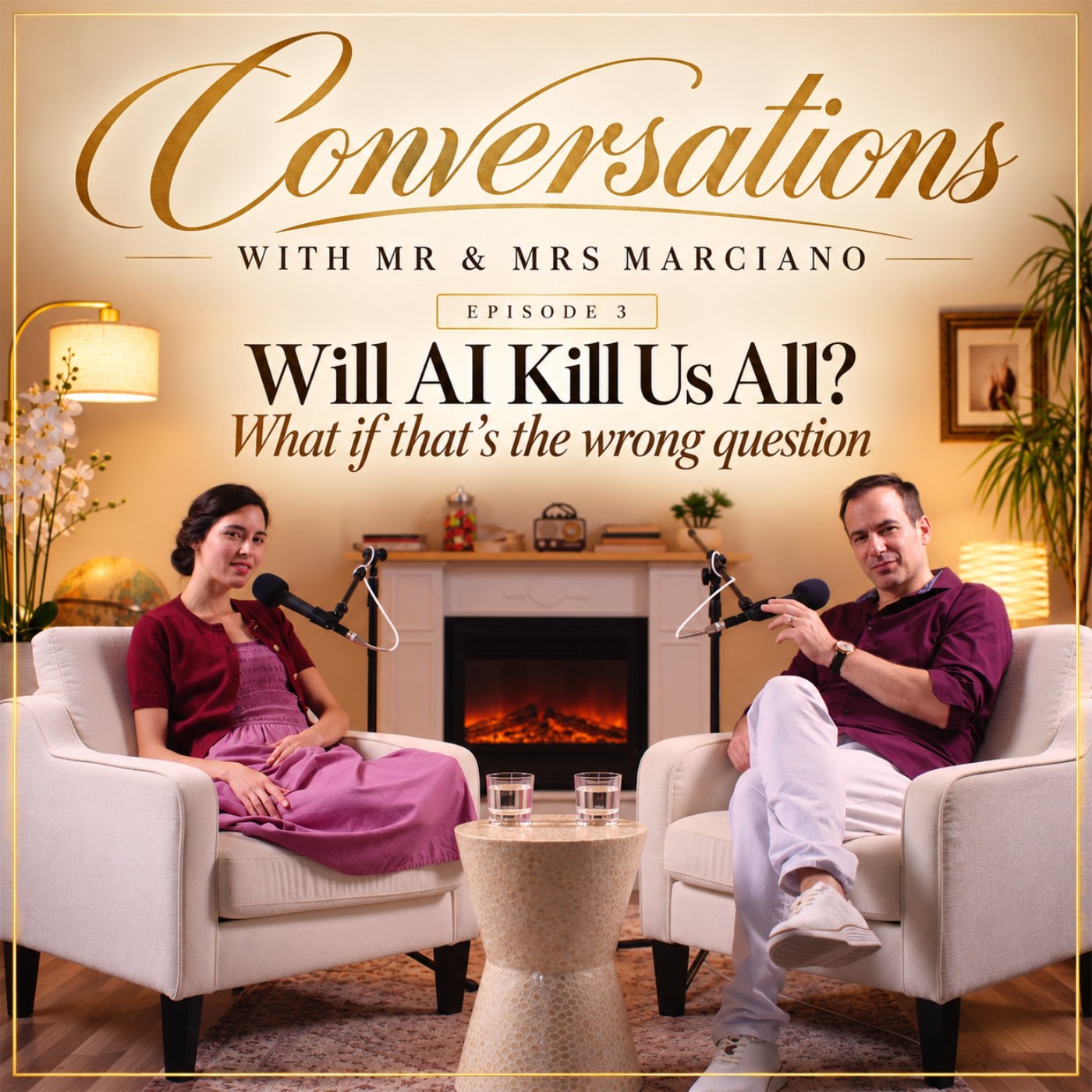
Will AI Kill Us All? What If That’s the Wrong Question?
October 6, 2026 · 28:42
We started with the question everyone seems to be asking: Is AI going to kill us?
But the conversation quickly became less about a future superintelligence and more about what AI is already changing around us.
One of us works extensively with AI and remains surprisingly optimistic after seeing both how capable and how unreliable it can still be. The other is more concerned about privacy, oversharing, dependence, manipulation and how quickly we are allowing AI into everyday life.
So instead of trying to predict the end of humanity, we ended up asking something more immediate:
What if we are afraid of the wrong things?
Show notes
Is AI going to kill us?
That sounded like the obvious place to start.
There is no shortage of warnings about artificial intelligence, superintelligence and what could happen if machines eventually become more capable than the people controlling them.
But once we started talking, the bigger question became something else.
One of us works with AI and AI agents extensively. They can already accelerate work, process enormous amounts of information and build things that once required considerably more time.
They can also misunderstand instructions, ignore constraints, invent things that do not exist and get completely lost in surprisingly simple situations.
That experience makes one of us far less afraid of the classic “AI takes over the world” scenario.
The other sees the threat differently.
What happens when people begin sharing more and more of their private lives with AI?
What happens when hiring, work and opportunity are increasingly filtered through automated systems?
What happens when we begin depending on answers we cannot always verify?
And what happens when technology changes faster than people and society can realistically adjust to it?
We talk about AI employees that require more micromanagement than expected, job displacement, hiring systems, personal data, privacy, corporate incentives, unreliable answers, convenience, dependence and a generation that may grow up never knowing a world without AI.
We do not have a prediction for where artificial intelligence is going.
But after this conversation, we are not sure that “Will AI kill us?” is even the most useful question.
Maybe the more interesting question is what happens to us long before it ever gets that far.
That sounded like the obvious place to start.
There is no shortage of warnings about artificial intelligence, superintelligence and what could happen if machines eventually become more capable than the people controlling them.
But once we started talking, the bigger question became something else.
One of us works with AI and AI agents extensively. They can already accelerate work, process enormous amounts of information and build things that once required considerably more time.
They can also misunderstand instructions, ignore constraints, invent things that do not exist and get completely lost in surprisingly simple situations.
That experience makes one of us far less afraid of the classic “AI takes over the world” scenario.
The other sees the threat differently.
What happens when people begin sharing more and more of their private lives with AI?
What happens when hiring, work and opportunity are increasingly filtered through automated systems?
What happens when we begin depending on answers we cannot always verify?
And what happens when technology changes faster than people and society can realistically adjust to it?
We talk about AI employees that require more micromanagement than expected, job displacement, hiring systems, personal data, privacy, corporate incentives, unreliable answers, convenience, dependence and a generation that may grow up never knowing a world without AI.
We do not have a prediction for where artificial intelligence is going.
But after this conversation, we are not sure that “Will AI kill us?” is even the most useful question.
Maybe the more interesting question is what happens to us long before it ever gets that far.